How Big Is a Babie Brain After One Year
Our brain is a vital part of our life experience. From the ability to think to the control of our muscles, our brain enables us to do everything. Only what virtually the things our brain does without us consciously thinking near it? In this list, we'll uncover the secrets of how our brain causes usa to practice things that nosotros rarely—if ever—call up about.
ten Filtering information
It goes without saying that every second of every day, we're constantly flooded with information—and then much information that information technology'southward impossible to have it all in. Without looking, do you know what color socks you put on this morning? What about what the first person you saw today was wearing? If not, don't worry, your retentivity isn't fading still! Our brain works constantly to filter out data nosotros don't need to consciously be fabricated enlightened of. This allows us to focus on what information is important to us. For example, if you're watching a game of football, you're probably not aware of what'southward going on in the crowd, even though your brain is perceiving this data.
This process is called selective attention and allows us non to be driven insane past the high levels of information that are typically present. Some information can, however, break through the barrier of our focus. This is why when we hear our name in someone else'due south conversation, we instantly respond. An experiment to test this theory was carried out by Christopher Chabris and Daniel Simons at Harvard Academy, a clip of which can be view above. How many times do y'all see the players in white pass the ball? The respond might surprise you lot.
9 Blinking
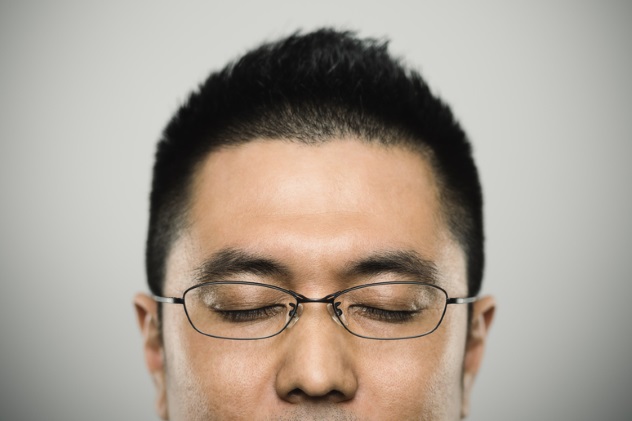
Blinking is something nosotros all practise approximately every two to 10 seconds; nosotros only e'er realize nosotros're doing information technology when someone points it out. (Now you lot're probably going to read the rest of the list thinking virtually information technology.) Only how does our brain manage to keep this process going with no conscious input? Blinking is an automatic reflex action, put in place to protect and maintain the moisture of your middle.
The outside corner of your eyes constantly produce tears. These tears are wiped away past the movement of your eyelids as yous blink to keep your eye lubricated and make clean. (This explains why our blinks are so evenly distributed.) The automatic system that regulates our blinking patterns as well makes sure that our eyelids shut when something is well-nigh to strike our face up. Although we have the ability to stop the process when we call back consciously nearly it (if you choose to accept a staring contest), the automatic system will somewhen force us to blink again.
8 Moving Our Tongue Into Position To Produce Words

When nosotros're talking, the merely thing we're consciously thinking nearly is what we're maxim. What we don't recollect about is the manner that the muscles in our natural language and mouth synchronize together to enable u.s.a. to verbally articulate linguistic communication.
Initially, we larn to talk through simulated. Nosotros don't necessarily imitate full sentences but rather piece together different words we hear earlier we start to be able to interpret pregnant, creating a structure for our words to exist placed in. As nosotros are imitating and learning these new words, our brain has to think consciously about how to position our tongue to create the intended audio.
However, as our power to pronounce each sound becomes more developed, our conscious mind is no longer involved in the process of positioning our tongue and lips; information technology has become an involuntary process. This explains why when we're talking, we don't consciously think about where our tongue is. The movements have already been learned by our muscles, and our brain automatically positions our tongue while nosotros're consciously thinking nigh what we're trying to say.
vii Deceiving Us Into Thinking We're Better

Imagine y'all have a child who really wants to exist an creative person, and they bring you a merely awful drawing which they seem to be very proud of. What practise you say to them? Most parents would complement the drawing, even if they don't believe what they're maxim. However, when the child grows up, they may look at the drawing and be horrified that anyone could ever have considered it to exist good. When somebody gives u.s. positive feedback, we build a conventionalities that we fit the criteria we are described as. This changes our perspective of ourselves, significant that nosotros believe nosotros're amend than we actually are.
This concept extends further than talents that have no scientific measurement. A study carried out in the documentary (Dis)Honesty: The Truth Nearly Lies demonstrated how people who believe that they did well on a test are more likely to answer confidently in a post-obit test, fifty-fifty though neither their cognition nor the ease of the chore has changed. In the experiment, participants were given the answers to the first set of questions at the bottom of the page and told that they may expect at them if they wished to. Not surprisingly, they did very well on the test. In the second test, no answers were provided, but because the participants had deceived themselves into thinking they were better (even though they cheated on the previous test), they answered questions more speedily and did not erase errors. Despite their conviction, their results plummeted compared to the first test.
6 Regulating Temperature

Not only does our encephalon control our social processes, merely it also regulates things within the body, such every bit temperature. It's vital to our wellness that our temperature stays at 37 degrees Celsius (98.vi °F); this temperature creates the perfect conditions needed for our body to behave out processes that proceed us fully functional, such as providing optimal conditions for digestive enzymes to work in. But how does our brain manage to maintain this constant temperature without us having to always think about it?
Our external environment is detected by sensory receptors in the skin. This information travels through our nervous system to the hypothalamus in the brain. At that place are also receptors in the claret that alarm the hypothalamus to changes in our internal body temperature. Once the temperature is interpreted, the brain tin take the advisable action to make sure the body stays at the correct temperature. For example, if our external environs is cold, the brain will instruct the hairs on our arms to stand up up, which allows them to trap more oestrus. Nevertheless, if our external environs is also hot, our brain instructs the body to produce sweat, allowing us to lose body heat through evaporation.
5 Changing Our Memory

Many of us are under the impression that in one case we've experienced something, we volition call back it simply as it happened; whatsoever differences in our power to retrieve information from the effect are due to our memory of it having faded. Still, a psychological study performed by Elizabeth Loftus and John Palmer in 1974 demonstrated that more goes into it than just that.
In the experiment, participants were shown clips of car crashes and asked a standardized set of questions most what they saw. The participants were put into dissimilar groups, all of which were asked the same question just with slightly different wording. The participants in two groups were asked what they thought the speed of the car was, but the verb used to draw the collision was "hit" for one grouping and "smashed" for the other. A control group wasn't asked about the speed at all.
A couple of weeks subsequently, participants were asked questions again nearly the clips they saw. This time, they were asked, "Did you come across any broken drinking glass?" There was no broken drinking glass in the prune. Participants who were told that the cars "smashed" (and who predicted the cars to be at a higher speed) inaccurately recalled seeing broken drinking glass far more than than the participants in the control and "striking" atmospheric condition. This suggests that our encephalon can recreate elements of a retentivity from new information given to it, which becomes stored as part of our original memory, resulting in a false memory.
4 Maintaining Residue

When we're walking, nearly of the states don't call up twice about it. What we fail to consider is how much our encephalon is working to ensure that nosotros maintain a stable balance. The encephalon works out how to maintain this balance through sensory input from the optics, muscles, joints, and vestibular organs.
Our optics are able to perceive the world effectually u.s.a. through lite hitting the rods and cones in our retinas, which send visual impulses to the brain, alerting information technology to where objects and other stimuli in the environment are in relation to us.
Muscles and joints are responsible for sending signals to our encephalon about the amount of stretch and pressure while walking. When we lean forward, more than pressure is felt in the forepart part of the soles of our feet. Any movement made by our torso parts sends a betoken to our brain, which allows it to gauge where we are in infinite. Cues given from the ankle besides allow our encephalon to measure the texture and quality of the surface, which enables us to accurately sway in relation to the basis.
3 Making U.s. Sneeze

Sometimes the overwhelming urge to sneeze can seem to come from nowhere. Although sneezing tin be caused past allergies or a stimulus causing an itch, more often than not, we don't realize there is something in our nose bothering usa until we sneeze to remove the irritation.
When we sneeze, the irritation is located in the respiratory epithelium lining the nose. Mast cells, such as inflammatory cells like eosinophils, produce chemicals such equally histamine or leukotrienes. This chemic release is triggered by the irritating substance, which tin can be something that triggers as an allergen; filtered particles, a viral respiratory infection, or a concrete irritant like smoke. After the irritating stimulus triggers the chemic release, vessels in the nose leak fluid, which ultimately stimulates nerve endings, causing itching. Merely how does our brain actually produce the sneeze?
The stimulation of each nerve ending activates a reflex response within the encephalon. The sensory fretfulness crusade the activation of nerves controlling the muscles in the neck and head. The rapid air flow from the nose is achieved by a buildup of pressure within the chest while the vocal chords are closed (all which is part of the reflex action). As the song chords rapidly reopen, the air flows out with high velocity, simultaneously removing the irritating stimulus.
2 Shivering

We've probably all experienced shivering when we've been out in the cold for as well long. But what is it that actually causes our body to shake uncontrollably?
Shivering is another reflex activeness put into identify for our ain protection. The reaction is created by triggering the hypothalamus, which is located simply higher up the thalamus in the encephalon. When sensory receptors in the skin observe a cold temperature in the external environment, our nervous organisation sends a indicate to the hypothalamus to alert information technology to this data. The hypothalamus then sends signals to your muscles, causing them to rapidly contract.
Shivering raises our body temperature. Despite our all-time efforts non to shiver, it is out of our command, beingness a reflex action. Whenever your hypothalamus detects temperature beneath a certain point, it kicks in the shivering reaction, which will non stop until the temperature is raised in a higher place a sure indicate.
i Laughing

Have you always been in a serious situation where laughing would exist completely inappropriate, yet for some reason you only couldn't concord back the giggles? Don't worry, you lot can blame your brain!
A paper published in 1998 gave some explanation as to how the brain is involved in our impulse to laugh. A girl labeled equally A.K. is discussed in the paper subsequently having undergoune surgery to control her epilepsy. The medico discovered that stimulating a roughly four-foursquare-centimeter (0.half dozen in2) area of the superior frontal gyrus (role of the frontal lobe of the encephalon) always triggered laughter from A.K. This area of the brain is a part of the supplementary motor surface area. When A.K. explained why she was laughing, she thought of something subsequently the laughter. This is usually the opposite for nigh people, every bit we perceive something as funny and so laugh equally a response.
Authors of the paper believe that our experience of laughter is triggered by several different areas of the encephalon, each responsible for adding different elements to the experience. There'southward the emotional reaction, the cognitive procedure of understanding why something is funny, and ultimately the uncontrollable function of the reaction, which involves the movement of facial muscles to create a grinning. Afterwards interpreting something as funny, our physical reaction to the situation is created by our brain's reaction, making is very difficult to control.
17-year-old student. Interested in writing and discovery.
Source: https://listverse.com/2016/07/08/10-things-our-brain-does-without-us-thinking-about-it/
0 Response to "How Big Is a Babie Brain After One Year"
Post a Comment